
‘Where you go?!’ the border guard snaps, raising his hand to halt my stride.
‘Iraq,’ I reply, pointing north, towards the simmering desert horizon.
‘No walk Iraq’ he commands, ‘get bus,’ and he points back over my shoulder, a kilometre down the road.
‘There?’ I ask, pointing towards what looks like a scrapyard.
‘Yes, yes, bus. Go there,’ and he encourages me with a wave of his arm, ‘go, go.’
Under a looming midday sun I trudge towards the scrapyard, away from the towering beige archway that marks the end point of Kuwait. The road is scattered with witch's hats and bollards, and dusted in a film of sand, the grains scratching under my feet. As the scrapyard nears it turns out to be nothing more than a carpark, though many of the cars have seen better days. At the edges of the carpark, taxi drivers sit and wait, hoping to find a customer for the return trip to Kuwait City. Highway 80, the so-called Highway of Death, gained its moniker during the 1991 Gulf War when the US led coalition shelled fleeing Iraqi forces. These days, the enormous 12 lane highway is flanked by distant oil fields, camel farms, and roadside shacks selling snacks and soft drinks. Although, given the speed at which some of the cars travel, the label may still be apt.
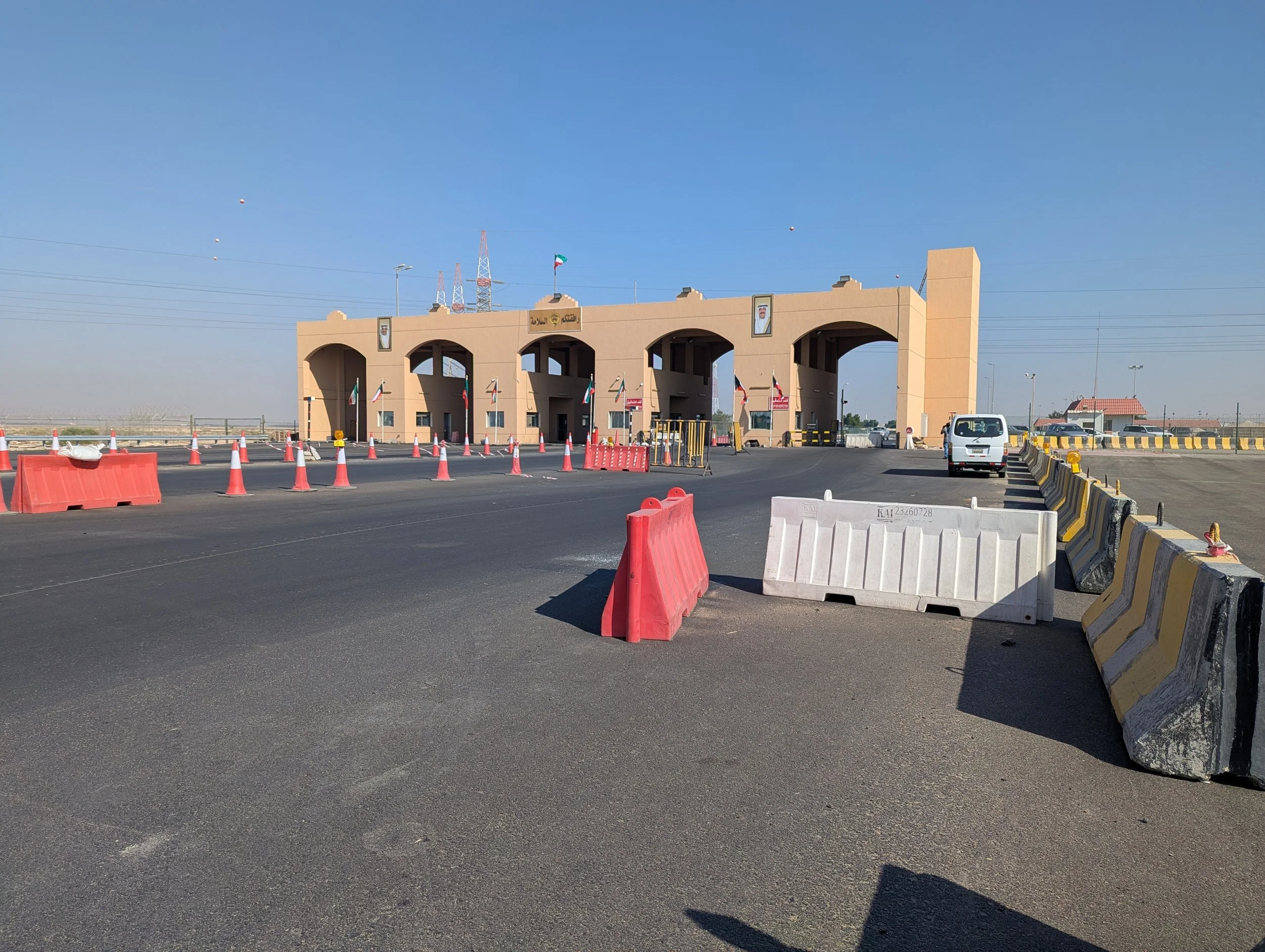
The Kuwaiti side of the Safwan border crossing
Within the carpark a bus sits idling in front of a demountable office block. A ragged Kuwaiti flag flaps in the breeze, clinging to a warped plastic flagpole wedged into the cladding. On a wooden bench a man sits smoking a thin white cigarette. His wrinkled hands hint at a lifetime of manual labour, and in this unforgiving desert everything appears prematurely aged. The bus has also seen better days, its royal blue sheen stripped from years of sandstorms and simmering heat. The sandblown rusted hulk is now in semi-retirement, consigned to ferrying travellers across the Safwan border crossing.
The bus driver is slumped over the wheel, dozing. When I heave my backpack onto the metal steps he wakes with a start.
‘Sa…laam al…ai…kum,’ he mumbles, barely able to complete the greeting. His words float in the air like dandelion spores, and are quickly swept away, vanishing into the emptiness of the desert.
‘Wa alaikum assalam,’ I reply, though he does not hear me.
Inside the bus, five men, and a woman wearing a black abaya and hijab sit in silence. Soon, two more passengers arrive, and the woman decides they have been waiting long enough. She harangues the driver from her position at the rear of the bus and concludes with a commanding ‘yalla,’ or ‘let’s go.’ There is a murmur of agreement from the rest of us and the driver reluctantly shifts upright in his chair, readying himself for the ten minute journey.
As we pull out from the carpark I notice the man sitting opposite is holding a British passport. His jet black beard and salt and pepper hair give away his Iraqi heritage, and after greeting him, Talal explains that he has been living in London for the past 15 years. Originally from Basra, the first major town over the border, he is on his annual trip home to visit family and friends.
‘Is this your first trip to Iraq?’
‘Yeah,’
‘You will love it,’ he assures me, ‘do you have anyone meeting you on the other side?’
‘No,’
‘Ok, my brother is coming to pick me up. If you want, you can come with us.’
‘That would be great, thanks,’ and before I even enter the country, I have my first experience of Iraqi hospitality, something that will define my journey.
‘I’ll come with you through immigration too,’ Talal continues.
At the immigration counter two female officers flick through my passport. They pause on a page, point, and giggle.
‘What’s funny?’ I ask, but they shake their heads and wave me away, too bashful to reply. When they hand my passport back I flick through the pages and find the offending image. The passport is emblazoned with images of Australia, and among the silhouettes of kangaroos and wattle are a couple of scantily clad women standing in the ocean.
‘We don’t dress like that in Iraq,’ Talal remarks, though it's a lighthearted moment on which to enter the country.
On the Iraqi side of the border, Talal and I stand in the shade of a tree, waiting for his brother to arrive. We talk about family, life at home and abroad, travel, politics, sport, and everything in between. Talal confides to me his wish to move back to Iraq. He is amused that since Brexit the emigration of British people has increased, ‘many of them want to come to Arab countries now, to make money.’
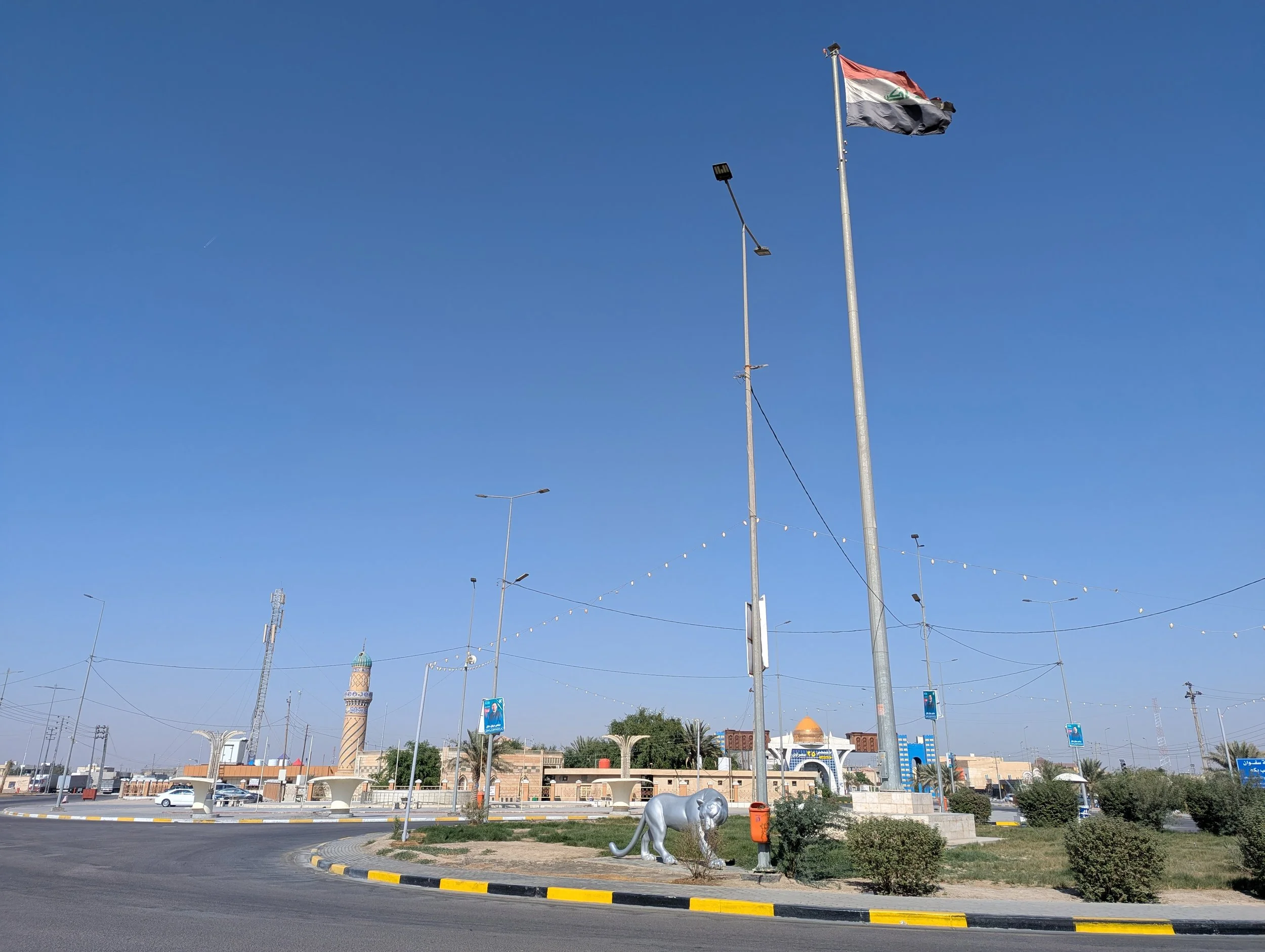
The Iraqi side of the Safwan border crossing
When Talal’s brother arrives he whisks us to Basra at speeds of up to 100 mp/h. All the time he is tailgating, weaving across lanes, and sounding his horn at every opportunity. For all the supposed dangers of travelling in Iraq, it seems that, like most places, traffic is the greatest risk to life. Talal and his brother drop me at a hotel and we exchange numbers ‘in case you need anything.’
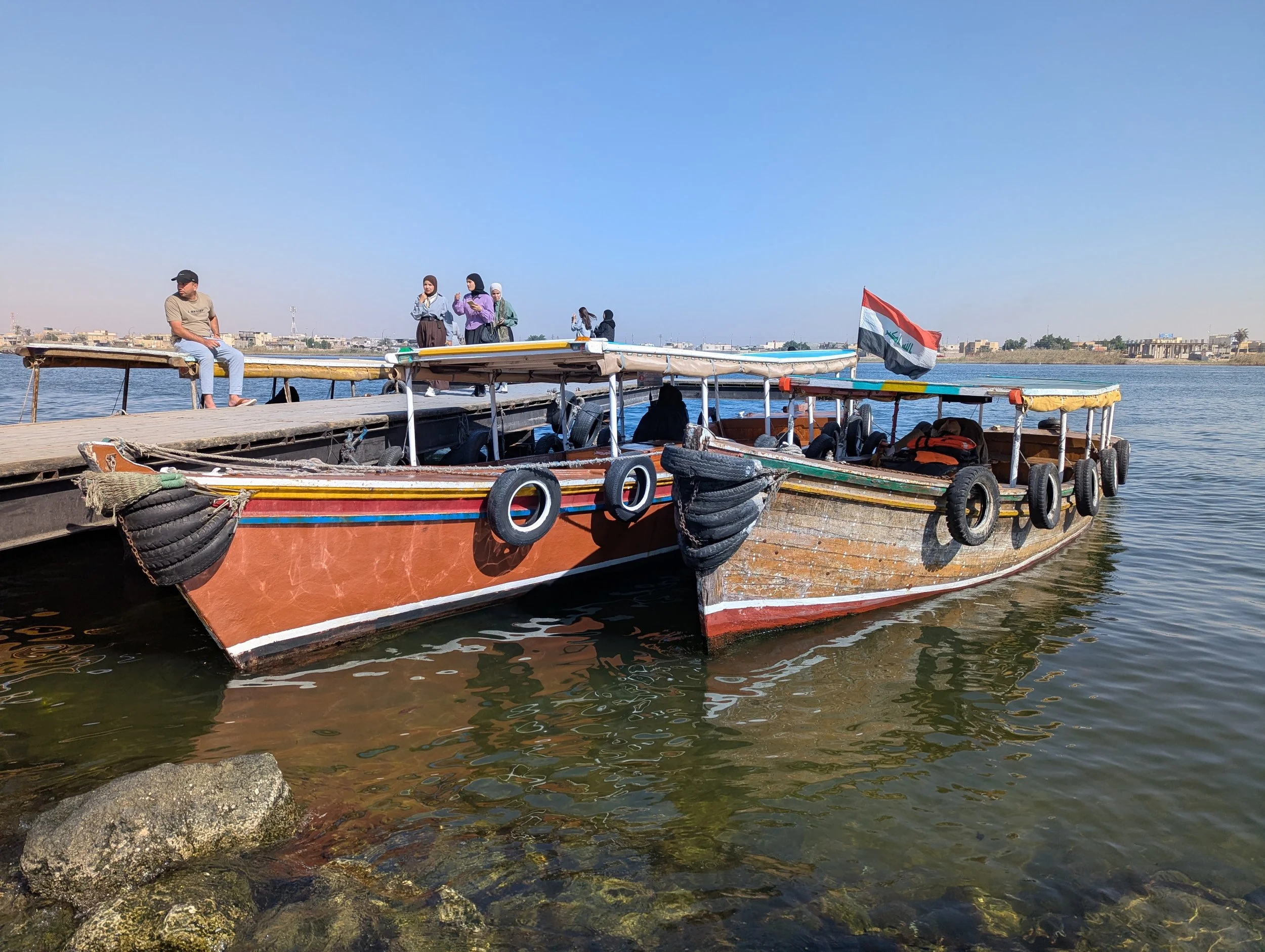
Basra boat cruises
The following day, just as I am wondering how I will spend my afternoon in Basra, Talal calls and invites me to ‘the mountain.’ I remember him pointing towards a hill when we were waiting at the border, though it was more of a mound, obscured by low clouds. I accept his invitation without hesitation, eager to experience more Iraqi hospitality. The receptionist at the hotel organises a taxi, and the driver, Ali, takes me back towards Kuwait, to the township of Khob al Zubair.
‘Are you sure this is the place?’ Ali asks.
‘Yeah, sure. Why?’
‘This place is like the ‘hood,’ he replies, ‘I don’t like to come here, and people from Basra are scared of this place.’
When we arrive at the meeting point, Talal is waiting beside a minibus and inside are a collection of his brothers, cousins, uncles, and nephews. He and Ali exchange pleasantries before he makes a hasty exit back to Basra. In the bus I am introduced to Mustafa and Saleh, Hassan and Saad, Musa, Murtada, and Faisal and I try to remember everyone’s name and position on the family tree. Faisal, a burly man with thick curly hair and a toothy grin, jumps up and bounces into the seat next to me.
‘How are you nice to meet you I am well thank you my name is Faisal I love you,’ he says in a garbled greeting, combining every English phrase he knows into one long sentence.
‘Nice to meet you Faisal,’ and the stunned look on my face sends the rest of the bus into fits of laughter.
‘Don’t worry about him,’ Talal assures me, ‘we call him The Joker.’
‘Joker, I am the Joker,’ Faisal announces, ‘I am well thank you I love you how are you.’
We drive through the streets of Khob al Zubair, which resemble nothing more than a rural township, and I wonder what Ali was worried about. Along the way we pick up a bag of fish, three crusty grills, and a nargeela pipe. The hunt for a bag of coals is unsuccessful, so we stop by the roadside and haul several logs into the minibus, laying them in the aisle.
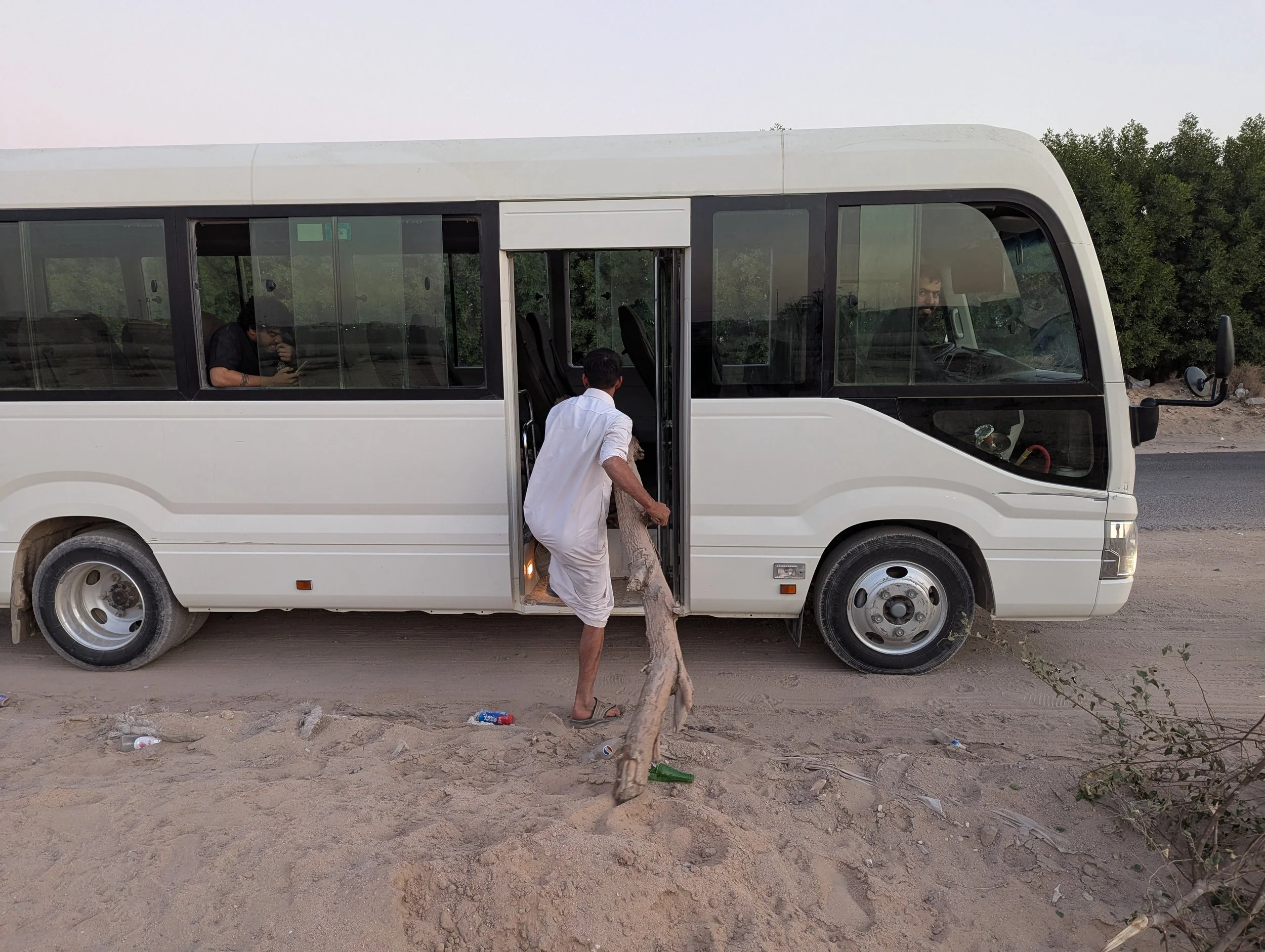
Saleh hauling a log onto the bus
At Sanam, which is more of a knoll than a mountain, the sun is easing behind the horizon. A mauve brushed sky quickly fades to black and the only light remaining burns from our fledgling campfire. It crackles and smokes, feeding voraciously on kindling and twigs. Hassan nurtures the fire, and attempts by anyone else to interfere are swiftly rebuked. It is nice to know that campfire etiquette is universal. Nearby, Faisal smokes nargeela on an unrolled carpet. The mint flavoured molasses is like smoking toothpaste. Meanwhile, Saleh and Mustafa prepare the carp, sprinkling the splayed fish with salt and rubbing it into the red flesh. Blood oozes onto the plate, some of it spilling over onto the sand. When complete, the dripping carcasses are placed inside the grills and positioned over the campfire.
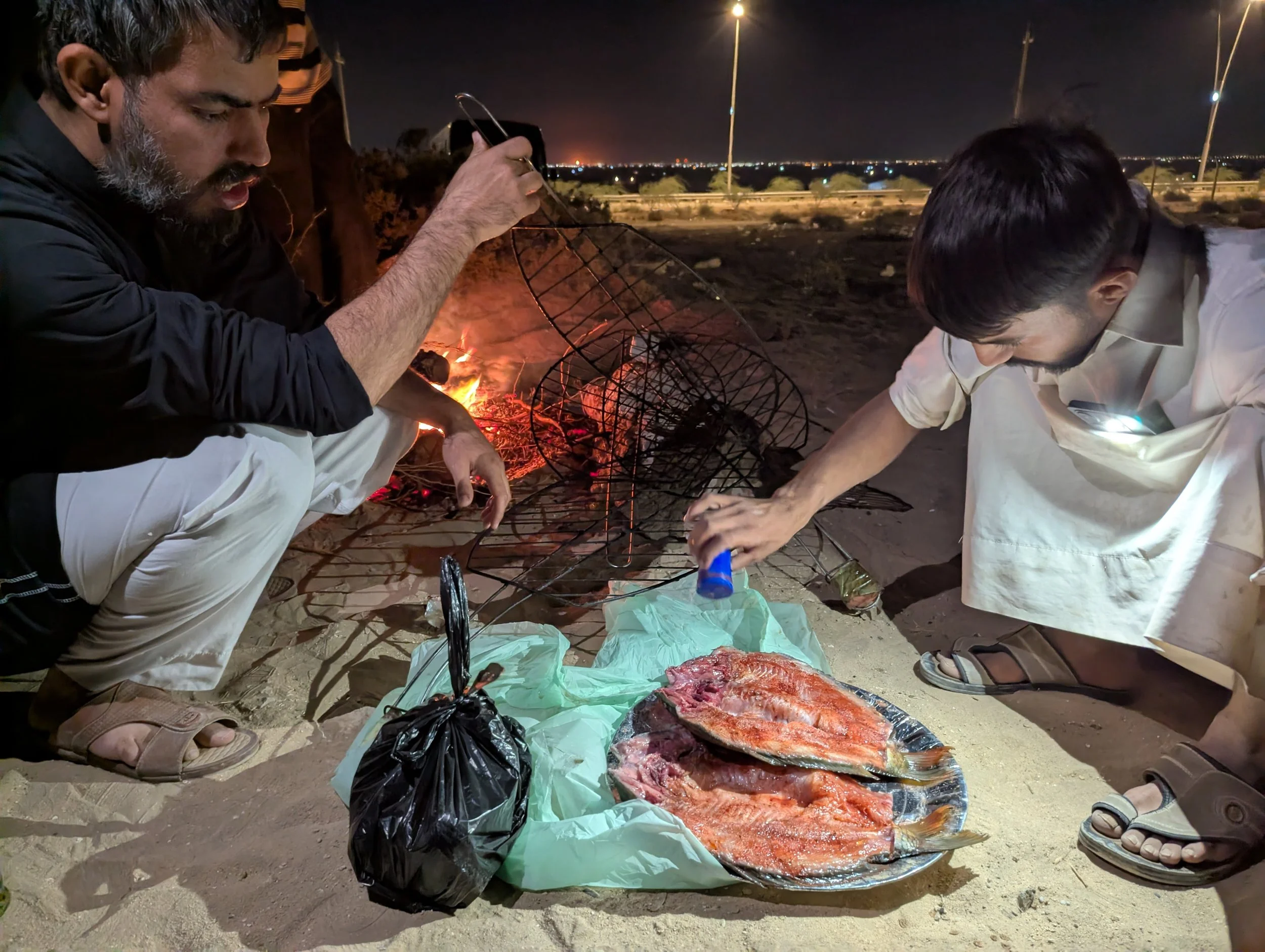
Mustafa and Saleh preparing the fish
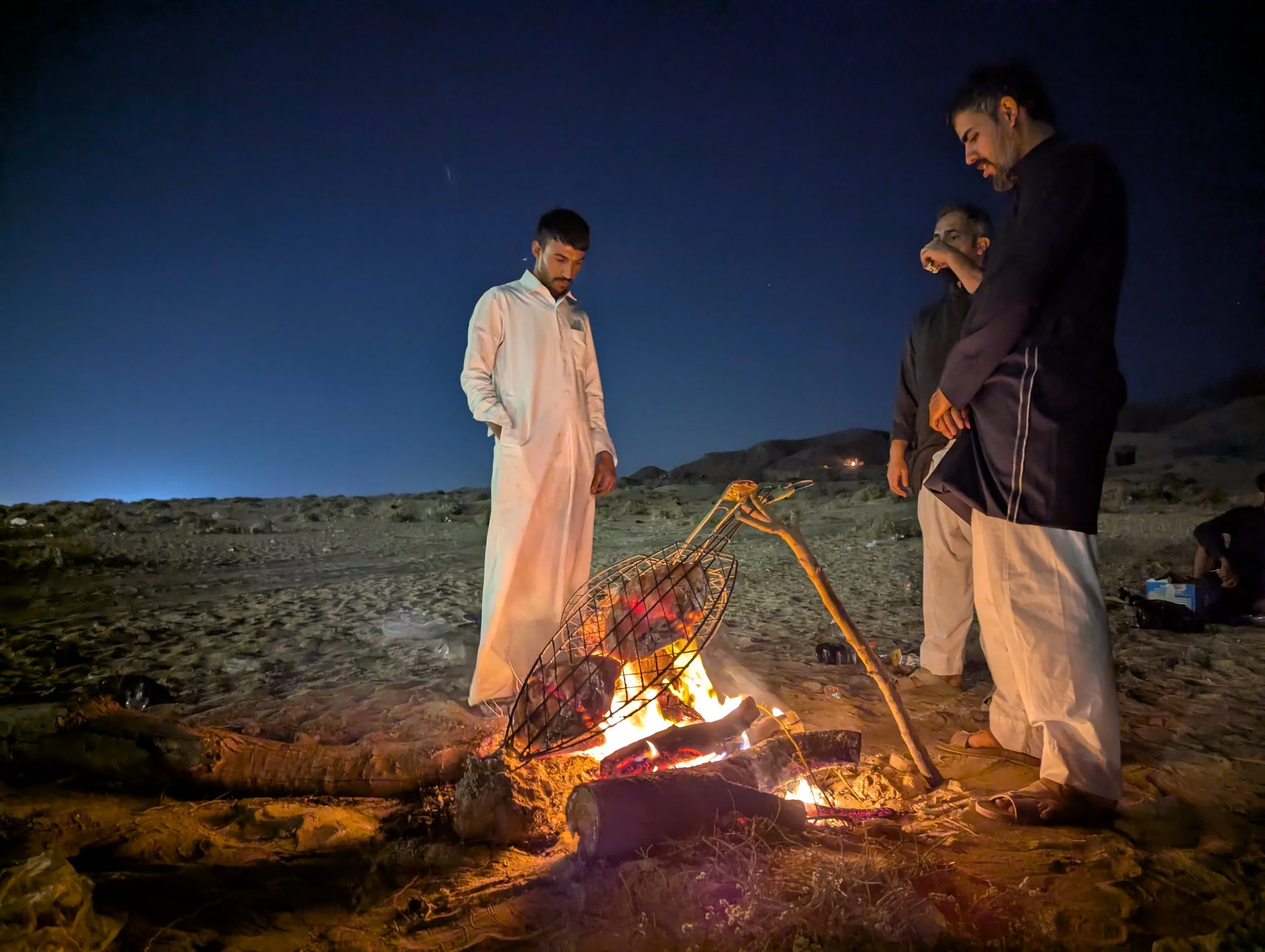
Saleh, Talal, and Mustafa by the fire
There is much that is lost in translation when travelling. Moments that pass us by, jokes that do not land, and subtleties missed. Yet there are some moments that transcend the need for a common language. Sharing a meal is one of these, be it with strangers, or new friends.
As we gather around the edges of the carpet, under a brittle crescent moon, Saleh and Mustafa drizzle the fish in lemon juice, and Hassan throws pieces of bread around the circle.
‘Alhamdulillah il-ladhee at’aamana wasaqaana,’ utters Talal, giving thanks to Allah for the meal, and then it is all hands in. Soon, only bones and breadcrumbs remain.
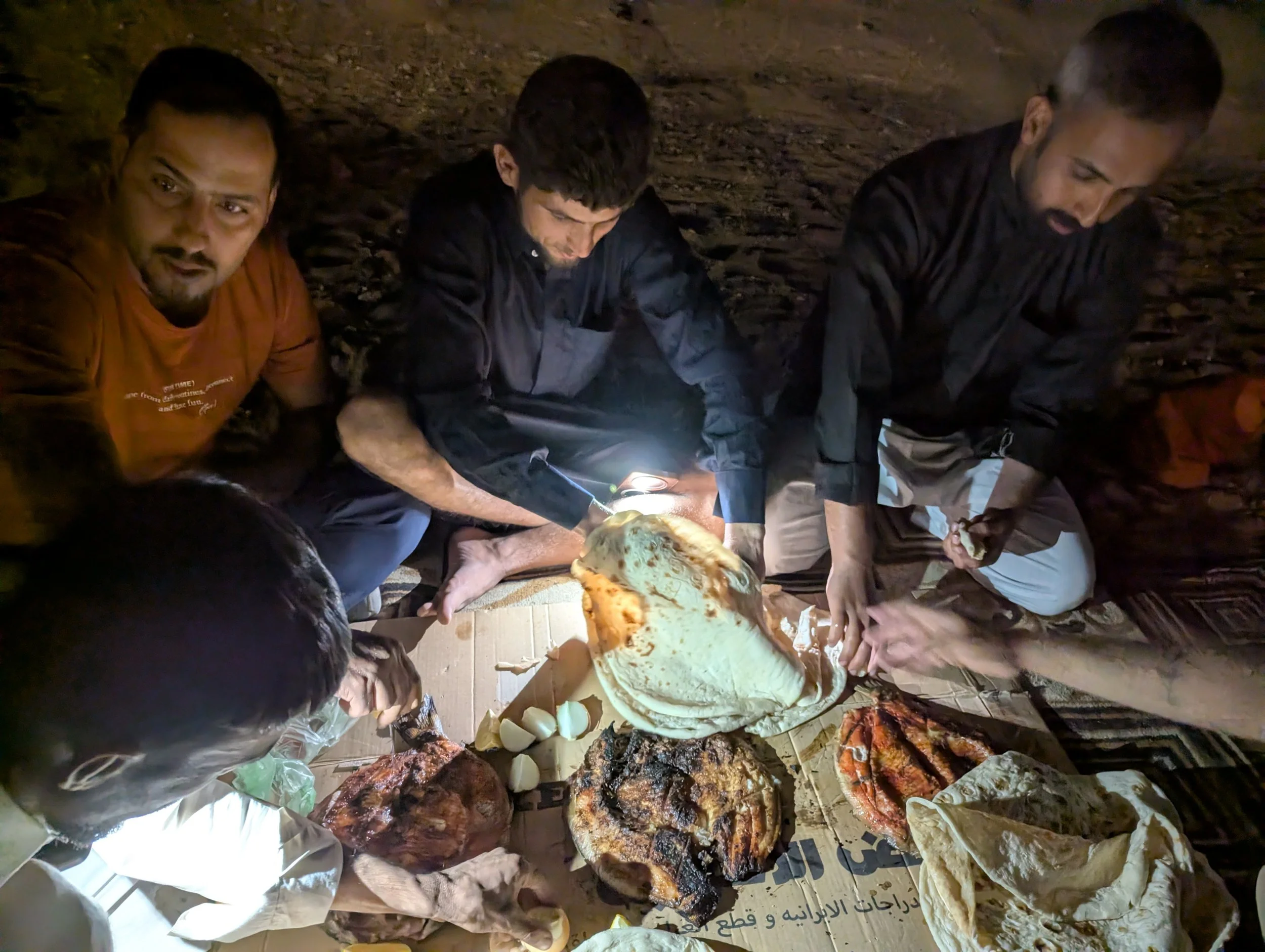
Dinner time!
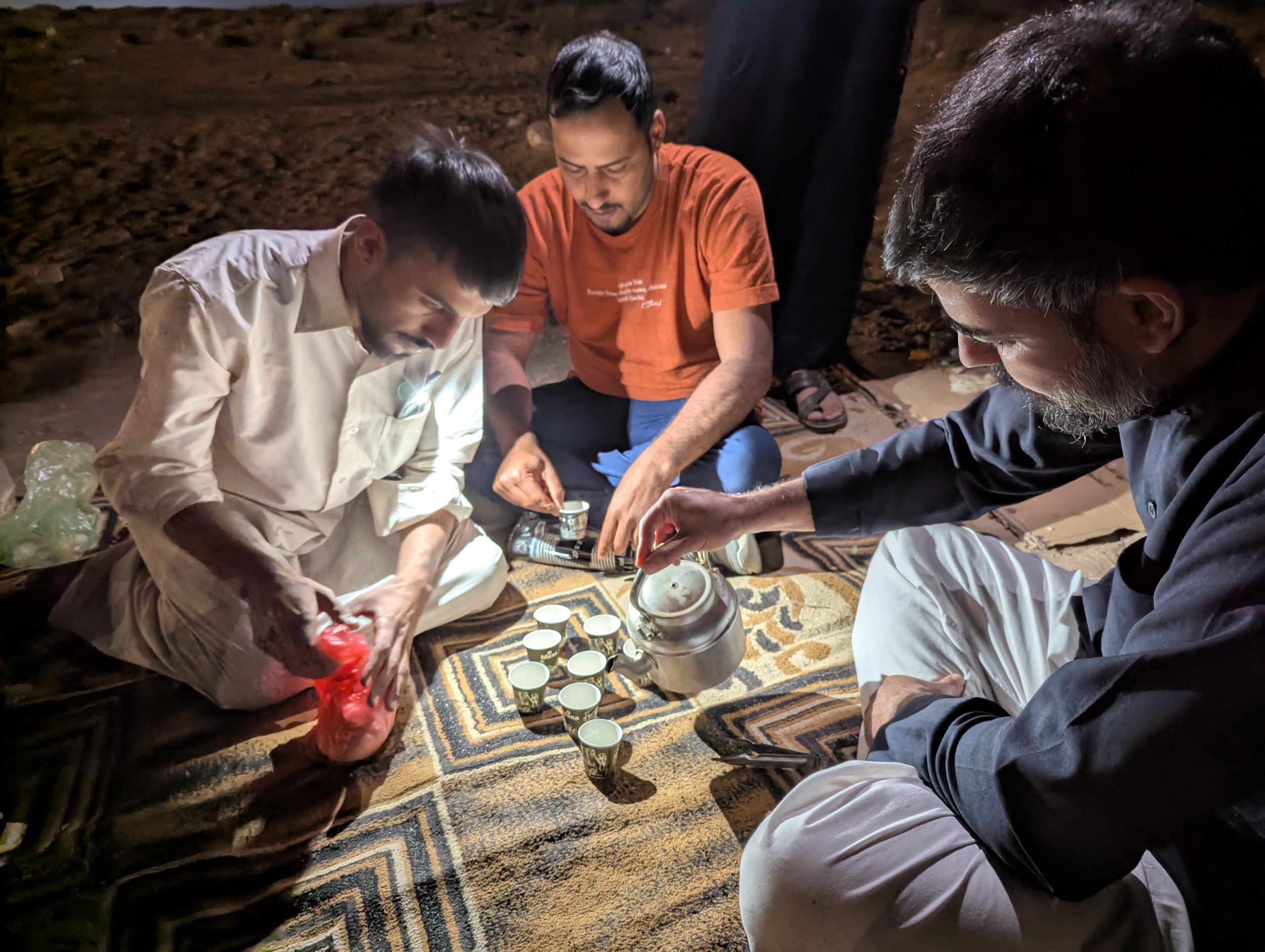
Because no meal is complete without tea
These are the moments that every traveller lives for - authentic experiences that cannot be contrived, purchased, or replicated. They occur only by chance, good fortune, and kindness. While language, culture, and distance may separate us, these are the moments that remind us how similar, and human, we all are.